If you want to understand where the Oklahoma City metro housing market is moving next, don’t just watch closings. Watch showings.Showings are one of the earliest indicators of

Dated: March 3 2026
Views: 89
If you’ve been watching real estate headlines lately, you’ve probably heard some version of: “Homes are still selling over list price.” And in the Oklahoma City metro, that statement is partly true—depending on what you mean by “over list,” and what’s happening behind the scenes of those contracts.
The two MLSOK graphs we’re looking at (Jan–Feb 2026 existing home sales) tell a more useful story than a simple “over list vs. under list” conversation:
What percentage of homes sold at or above list price
What percentage sold at or above list price with zero seller concessions
That second metric is the one most buyers and sellers feel in real life—because concessions are where the negotiations often hide.
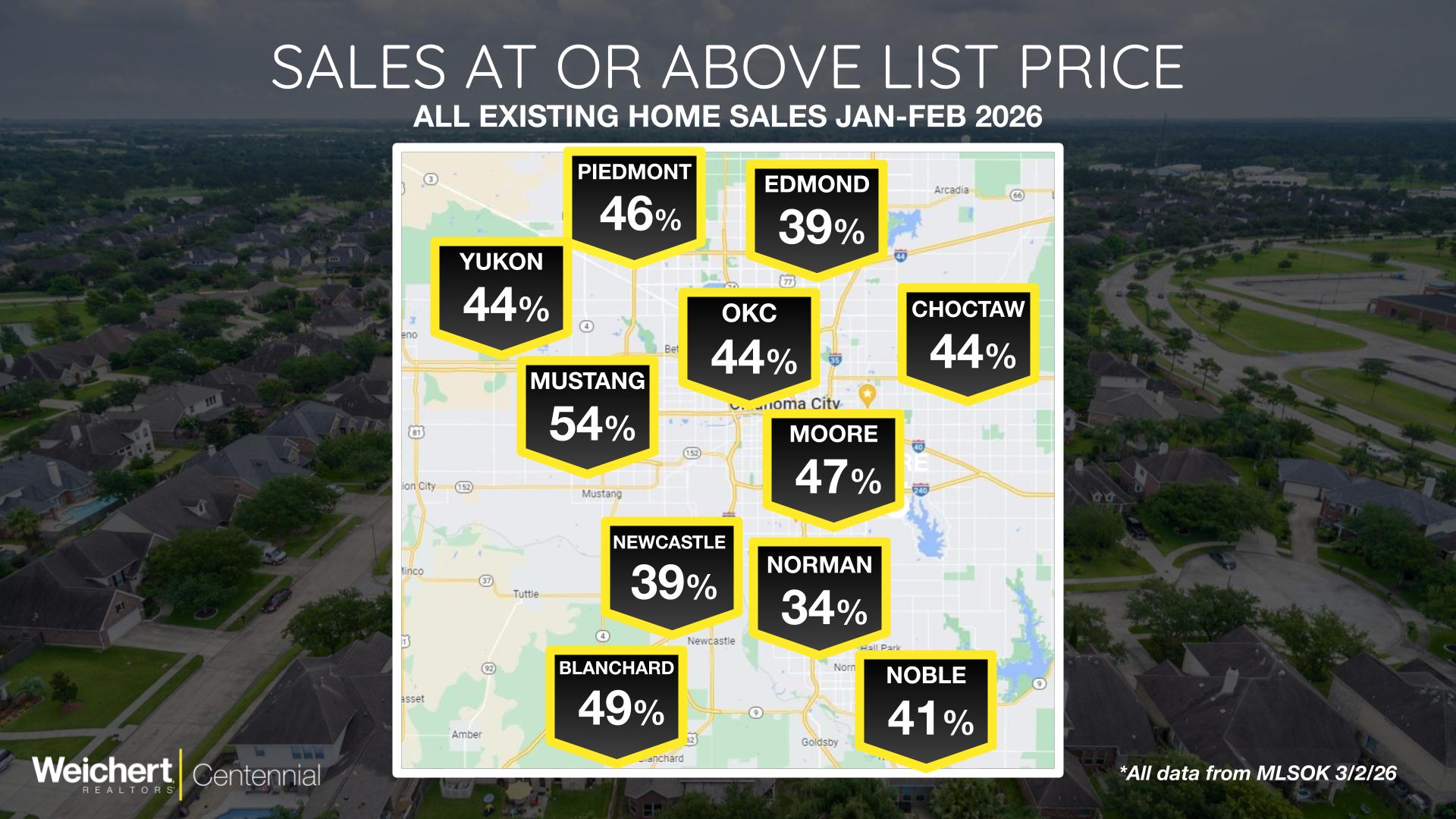
Across the OKC metro, a meaningful share of properties closed at or above list price. In plain English: buyers are still stepping up on price for the right homes—especially those that are clean, updated, and priced correctly from the start.
Several markets clustered in a similar “competitive but not chaotic” range, with a few areas pushing higher. That pattern matters because it tells us something about buyer behavior:
Buyers will pay up when a home is scarce (few comparable options)
Or when a home is turn-key (condition reduces uncertainty)
Or when the home hits the market in a high-demand price band for that town
So if you’re a seller, this graph is encouraging: you don’t necessarily need a “perfect” market to still command a strong price—if your home is positioned well.
But here’s the catch…
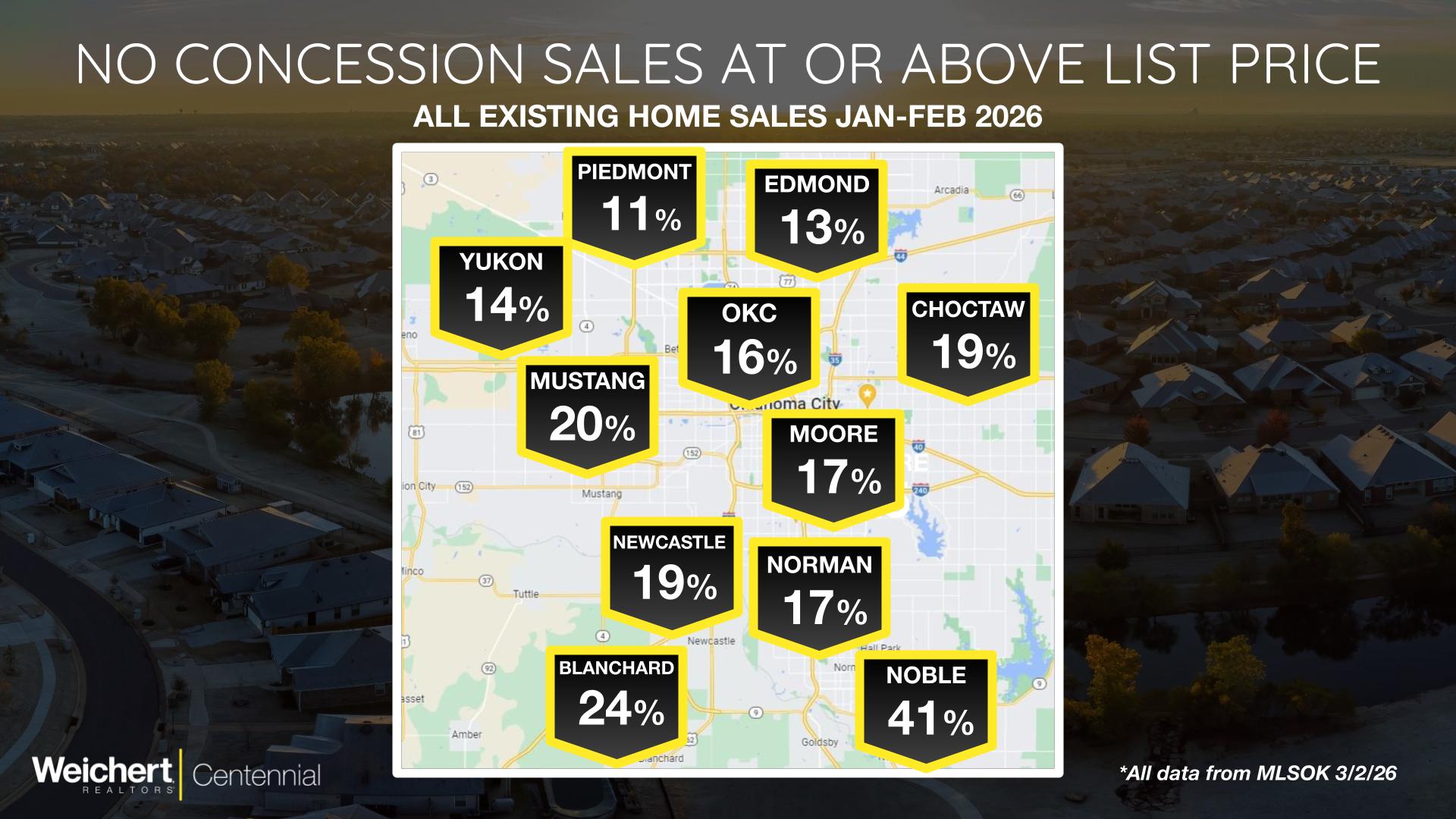
The second graph filters those at/above list deals down to the ones that also had no seller concessions. That’s the closest thing to a “clean” seller win: strong price and strong terms.
And this is where the reality of today’s market shows up: the no-concession share is much smaller than the at/above list share.
That gap tells us something important:
Many buyers are paying close to (or over) list price—but still negotiating value through concessions.
Concessions can look like:
Seller-paid closing costs
Repair credits after inspection
Pre-paid items or allowances
Rate buydowns (common when buyers are payment-sensitive)
So even when the final sale price looks strong on paper, the net result for a seller can be meaningfully different once concessions are factored in.
If your goal is a clean deal—strong price, minimal concessions—your strategy can’t be “just list it and hope.”
A clean win usually comes from:
Pricing precision (not optimistic pricing)
Presentation (condition and first impression reduce buyer uncertainty)
Pre-inspection fixes (small repairs often prevent big credits later)
Negotiation leverage (created by demand, not by insisting)
In markets where the no-concession rate is higher, you can often trace it back to one of two things: homes are priced in a hot bracket, or inventory is thin enough that buyers feel pressure to keep terms clean.
If you’re a buyer, these graphs should feel like permission to be smart—not hesitant.
Even if a home sells at or above list, you may still have leverage through:
inspection findings
appraisal realities
competing inventory nearby
time on market
seller motivation
The key is understanding that negotiating isn’t always about “getting the price down.” In this environment, many successful buyers negotiate through terms—especially if they’re trying to manage their cash-to-close or reduce surprise repairs.
The biggest mistake people make when interpreting the market is assuming that “over list” equals “seller’s market.”
In reality, price strength (at/above list) and term strength (no concessions) can move in different directions at the same time.
Jan–Feb 2026 in the OKC metro looks like this:
Buyers are still competing on the right homes
Sellers are still achieving solid pricing
But many transactions are balancing out through concessions
If you want an accurate read on your neighborhood—Piedmont, Edmond, Yukon, OKC, Choctaw, Mustang, Moore, Newcastle, Norman, Blanchard, or Noble—the best next step is to zoom in by price range and home condition, because that’s where the negotiation story becomes obvious.

I was born and raised in Guymon, OK. Never heard of it? That’s okay, most people haven’t! But growing up in a small town has instilled in me a love for community! In 2012 I moved to Norman, OK t....
If you want to understand where the Oklahoma City metro housing market is moving next, don’t just watch closings. Watch showings.Showings are one of the earliest indicators of
If you’ve been watching real estate headlines lately, you’ve probably heard some version of: “Homes are still selling over list price.” And in the Oklahoma City
As we enter March and the Spring real estate market in Oklahoma, you may be wondering how quickly homes go under contract. Let’s take a look!CURRENT VERSUS A POTENTIAL DROPOver the past 12
We dig through the data on the Greater OKC real estate market, so you can be an expert. Two of those numbers we love to track are the average seller concessions at closing and the number of homes
 Copyright© 2026 MLSOK, Inc. listing content is believed to be accurate but is not guaranteed. Subject to verification by all parties. The listing information being provided is for consumers personal, non?commercial use and may not be used for any purpose other than to identify prospective properties consumers may be interested in purchasing. This listing data is copyrighted and may not be transmitted, retransmitted, copied, framed, repurposed, or altered in any way for any other site, individual
and/or purpose without the express written permission of MLSOK, Inc. Information last updated on September 23, 2026 12:11 AM UTC
© 2026 OKC Metropolitan Association of REALTORS® (OKMAR). All rights reserved.
Disclaimer: All information deemed reliable but not guaranteed and should be independently verified. All properties are subject to prior sale, change or withdrawal. Neither listing broker(s) nor September 23, 2026 12:11 AM UTC shall be responsible for any typographical errors, misinformation, misprints and shall be held totally harmless.
Data last updated on September 23, 2026 12:11 AM UTC
Show More...
Copyright© 2026 MLSOK, Inc. listing content is believed to be accurate but is not guaranteed. Subject to verification by all parties. The listing information being provided is for consumers personal, non?commercial use and may not be used for any purpose other than to identify prospective properties consumers may be interested in purchasing. This listing data is copyrighted and may not be transmitted, retransmitted, copied, framed, repurposed, or altered in any way for any other site, individual
and/or purpose without the express written permission of MLSOK, Inc. Information last updated on September 23, 2026 12:11 AM UTC
© 2026 OKC Metropolitan Association of REALTORS® (OKMAR). All rights reserved.
Disclaimer: All information deemed reliable but not guaranteed and should be independently verified. All properties are subject to prior sale, change or withdrawal. Neither listing broker(s) nor September 23, 2026 12:11 AM UTC shall be responsible for any typographical errors, misinformation, misprints and shall be held totally harmless.
Data last updated on September 23, 2026 12:11 AM UTC
Show More...
